


Hot exciton dissociation in Nature Communications
31 07 2026
Silvio Osella contributed to the paper “Hot exciton dissociation in graphene nanoribbons“, published in Nature Communications.
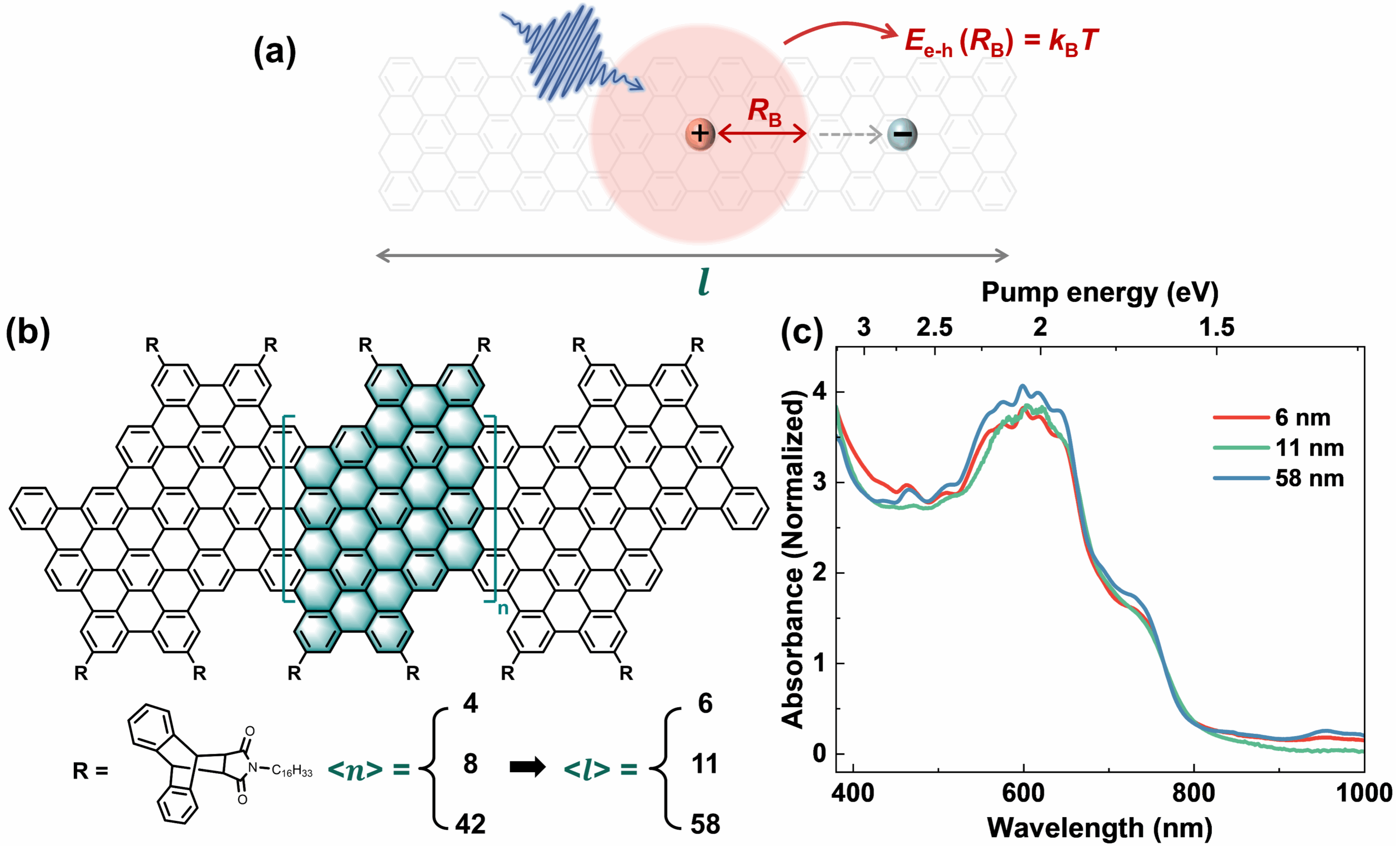
This collaborative paper presents graphene nanoribbons (GNRs) as a model system to investigate exciton dissociation, and particularly how the ribbon length, excitation energy and band dispersion affect the charge transport. Ultrafast Terahertz conductivity measurements reveal that hot exciton dissociation dominates carrier generation, with ribbon length significantly influencing free carrier lifetimes. A key parameter is the ribbon length, and at 20nm the photoexcited hot carriers can dissociate before forming tightly bound excitons, while for shorter ribbons rapid exciton formation prevails.
Our computational contribution elucidated the role of the electronic properties of the different ribbons, since the charge-carrier band dispersion plays a critical role in determining dissociation efficiency. Long GNRs with strongly dispersed bands, and consequently low effective carrier masses, exhibit higher mobilities that promote efficient hot-exciton dissociation.
These results advance fundamental understanding of dimensionality, energetics, and electronic structure in excitonic materials, providing design principles for optoelectronic devices based on excitonic materials.
Congratulations to the coauthors!