


Nature Chemistry featured contribution
31 07 2026
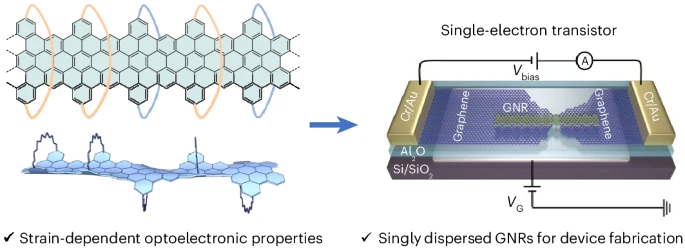
A team led by Xinliang Feng at the Technische Universität Dresden, Dresden, Germany, with contribution from Silvio Osella in our group at the University of Warsaw, reports a new shielding strategy to disperse single graphene nanoribbons (GNRs) in the Nature Chemistry journal. The introduction of cyclophane-based functional groups at the edge of the nanoribbons not only sterically protects the GNR backbone but also imparts internal strain, enabling singly dispersed GNRs while simultaneously modulating their optoelectronic properties. This shielding strategy is responsible for a marked increase in short-range charge carrier mobility—from 190 to 330 cm2 V−1 s−1 and enables the fabrication of single-electron transistors showing a clear Coulomb blockade behaviour at low temperatures.
Density functional theory was essential in explaining the electronic properties of these modified GNRs. The calculations compare the three different cyclophane chains, showing that the changes in length and functionalization are directly responsible for the decrease of the band gap and at the same time of the increase of the charge mobility.
J-J. Zhang, J. Zhang, G. Wen, S. Osella, Z. Qiu, S. Böckmann, X. Wang, B. Maib, Y. Fu, X. Yu, M. R. Hansen, J. Maultzsch, M. Calame, M. L. Perrin, H. I. Wang, M. Bonn, J. Ma*, K. Müllen, X. Feng* “Cyclophane-based Shielding Strategy for Singly Dispersed Graphene Nanoribbons” Nature Chem. (2026), https://doi.org/10.1038/s41557-026-02172-z.
Congratulations to the coauthors!